In this guide · 8 sections
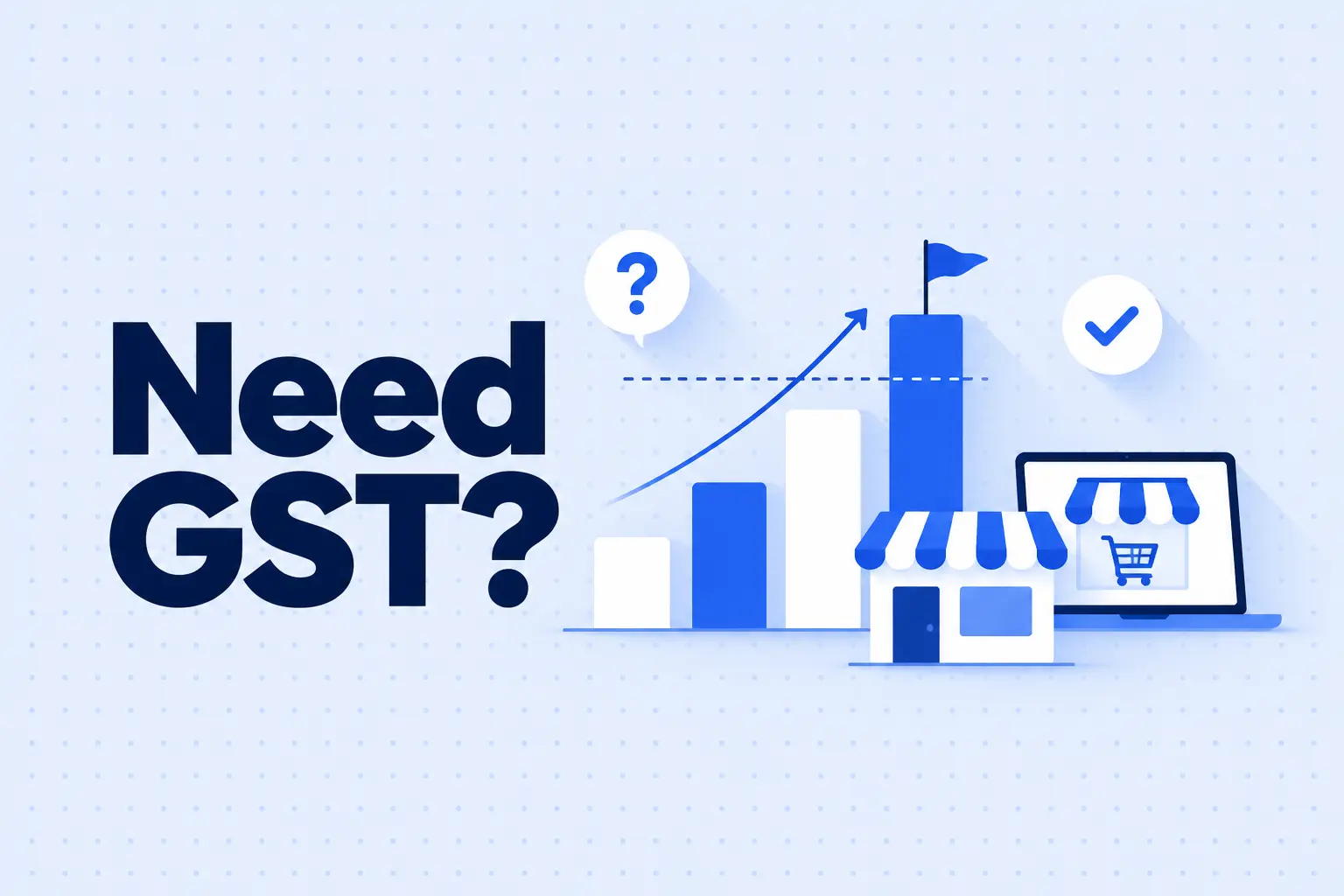
"Do I need GST?" is one of the first questions every new business owner asks. The answer depends on what you sell, where you sell it and how much you sell — and in some cases you need GST from your very first sale.
The turnover limits
You must register once your aggregate turnover in a financial year crosses the threshold:
| What you supply | Most states | Special category states |
|---|---|---|
| Goods only | ₹40 lakh | ₹20 lakh |
| Services, or goods and services | ₹20 lakh | ₹10 lakh |
The lower limits apply in some north-eastern and hill states, such as Manipur, Mizoram, Nagaland and Tripura. A few states have opted for the ₹20 lakh limit even for goods. Always check the rule for the state where you operate.
The ₹40 lakh limit for goods does not apply to some items such as ice cream, pan masala and tobacco products — suppliers of these follow the ₹20 lakh limit.
What "aggregate turnover" includes
Aggregate turnover is the total value, across India under the same PAN, of:
- taxable supplies
- exempt supplies
- exports
- interstate supplies
It excludes GST itself and inward supplies taxed under reverse charge. So even exempt sales count towards the limit.
When GST is compulsory, whatever your turnover
Section 24 of the CGST Act requires registration from the first sale in several cases:
- interstate supply of goods — selling goods to buyers in another state
- selling goods through e-commerce platforms like Amazon or Flipkart (small service providers on platforms have some relief)
- e-commerce operators themselves
- casual taxable persons — for example, selling at an exhibition in another state
- non-resident taxable persons
- people required to pay tax under reverse charge
- input service distributors
- people required to deduct or collect tax at source under GST
- agents supplying on behalf of others
Services across state lines: service providers supplying to other states get the same ₹20 lakh limit — they don't need GST from the first sale just because a client is in another state.
Voluntary registration
You can register even if you are below the limit. It makes sense if:
- your buyers are GST-registered businesses that want to claim input tax credit
- you want to sell on marketplaces that require a GSTIN
- you plan to grow past the limit soon
- you want to claim credit on large purchases
The trade-off is regular return filing, even in months with no sales.
Composition scheme for small businesses
If your turnover is up to ₹1.5 crore (₹75 lakh in special category states) for goods, or up to ₹50 lakh for services, you can opt for the composition scheme. You pay a small fixed rate on turnover and file fewer returns, but you cannot claim input tax credit, charge GST on invoices or make interstate sales of goods.
What happens if you don't register
Not registering when you are liable can lead to:
- tax due on all sales from the date you became liable, with 18% interest
- a penalty of 10% of the tax due, subject to a minimum of ₹10,000
- a penalty of 100% of the tax in cases of deliberate evasion
- loss of business from buyers and platforms that need a GSTIN
How to register
Registration is free on gst.gov.in. You need your PAN, Aadhaar, address proof of the business, bank details and a photograph. After Aadhaar authentication, approval usually comes within about 7 working days if there are no queries.
Frequently asked questions
Is GST registration free?
Yes. The government charges no fee. You only pay if you want a professional to prepare and follow up on the application.
My turnover is ₹15 lakh and I sell clothes online. Do I need GST?
Yes, if you sell goods through an e-commerce platform. Selling goods through e-commerce generally requires registration regardless of turnover.
I'm a freelancer with foreign clients. Do I need GST?
Exports of services count towards aggregate turnover. Once the total crosses ₹20 lakh, you need GST. Exports are zero-rated, and you can export without paying tax under a Letter of Undertaking.
Do I need separate GST registrations in different states?
Yes. Registration is state-wise. If you have a place of business in more than one state, each one generally needs its own GSTIN.
Can I cancel GST if my turnover falls?
Yes. If you are not otherwise required to stay registered, you can apply for cancellation after filing all pending returns.